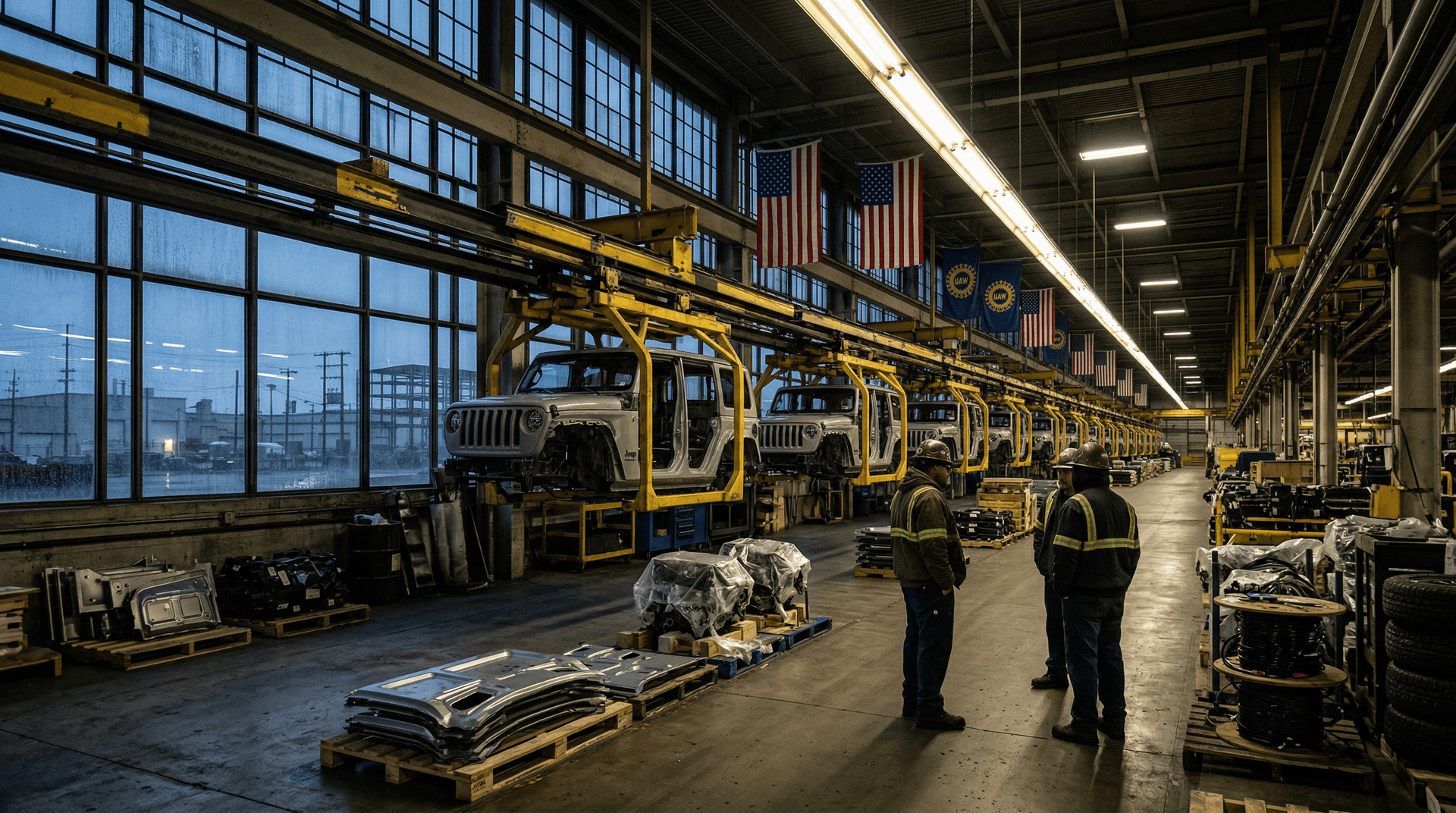
In a move that underscores the tightening financial pressures on the American auto industry, Stellantis announced on December 4 the elimination of approximately 350 salaried positions across its U.S. operations. This is part of a broader strategy to generate $1 billion in cost savings in 2024, as the company grapples with escalating labor expenses following the recent ratification of new United Auto Workers (UAW) contracts.
The layoffs come just weeks after the contentious 44-day UAW strike that ended in late November, which secured record wage hikes, better benefits, and job security guarantees for unionized workers at the Big Three automakers—Stellantis, General Motors, and Ford. For Stellantis, the new four-year deal includes immediate 25% wage increases, cost-of-living adjustments, and the reopening of the idled Belvidere Assembly Plant in Illinois. However, these gains for hourly workers are now juxtaposed against cuts in white-collar ranks, highlighting the delicate balancing act automakers face in a competitive global market.
Midwest Heartland Hit Hard
The Midwest, long the epicenter of U.S. auto manufacturing, stands to feel the ripple effects most acutely. Stellantis employs thousands in Michigan, where its Sterling Heights and Detroit Assembly Complex plants produce high-volume models like the Ram 1500 and Jeep Grand Cherokee. Illinois' Belvidere facility, shuttered since 2023, is slated for reactivation to build the next-generation Jeep Cherokee, a key provision of the UAW agreement. Yet, with salaried staff reductions, questions loom over engineering, supply chain, and administrative support critical to these operations.
"These are not easy decisions, but necessary to ensure Stellantis' long-term competitiveness," stated CEO Carlos Tavares in a memo to employees. The cuts target overhead functions rather than production lines, but industry analysts warn of potential downstream impacts. Michigan's economy, already strained by the strike's $8.6 billion hit to the state (per Anderson Economic Group estimates), could see further slowdowns if production ramps falter.
Local leaders expressed concern. Michigan Governor Gretchen Whitmer, a vocal supporter of the EV transition, noted in a statement that while she welcomes the UAW wins, "sustainable growth requires partnership between labor and management." In Illinois, Springfield-area officials near Lincoln Land are optimistic about Belvidere's revival but wary of broader industry headwinds.
Post-Strike Financial Pressures
Stellantis' North American shipment volumes dropped 19% in Q3 2023 amid the strike, contributing to a 34% plunge in adjusted operating profit. The company reported €885 million ($970 million) in third-quarter income for its North America unit, down sharply from the prior year. With UAW contracts adding an estimated $8.8 billion to labor costs over the deal's life—largely borne by Stellantis due to its later ratification timeline—the pressure to trim fat elsewhere intensifies.
Tavares has emphasized profitability over volume, pulling back on discounts that eroded margins in prior years. Stellantis shares dipped 2% following the layoff news but have held steady year-to-date, buoyed by strong Jeep and Ram sales. However, the automaker trails rivals in the electric vehicle (EV) race, where Tesla and GM are accelerating. Stellantis aims for 50% EV sales in Europe by 2030 and 40% in the U.S., but battery tech investments strain cash flows.
| Key Financial Metrics (Q3 2023) | |--------------------------------| | North America Shipments: -19% YoY | | Adjusted Operating Profit: €885M | | Net Revenues: €39.6B (group-wide) | | EV Sales Share: 12% in Europe |
Broader Industry Context
Stellantis is not alone. Ford announced 300 salaried job cuts in November, while GM has signaled similar measures. The Big Three's collective $11 billion-plus in new labor costs arrives as Chinese EV makers like BYD flood markets with low-cost alternatives and U.S. tariffs loom. Midwest suppliers—from tier-one firms in Ohio to smaller outfits in Indiana—face squeezed margins as automakers demand concessions to offset wage hikes.
The tech angle is pivotal: Stellantis is investing in software-defined vehicles via its new STLA Brain platform and partnerships like Mobile Drive with Foxconn for infotainment. Yet, layoffs could slow R&D in autonomous driving and ADAS (advanced driver-assistance systems), areas where competitors like Waymo (Alphabet) and Cruise (GM) lead. In the finance realm, Stellantis' €5.9 billion ($6.5 billion) cash pile provides a buffer, but investor patience wanes amid a potential 2024 recession.
Outlook for 2024 and Beyond
Analysts project Stellantis' 2024 industrial free cash flow at €6 billion, but downside risks persist from interest rates, supply chain snarls, and EV mandates under the Inflation Reduction Act. The Belvidere reopening, expected mid-2025, promises 1,500 jobs but hinges on market demand for gas-powered Jeeps amid electrification pushes.
For Midwest communities, the story is one of resilience tempered by caution. Lincoln Land Express spoke with UAW Local 1268 in Belvidere, where members hailed the contract but urged fiscal prudence. "We've won historic gains, but the company must innovate to survive," said one steward.
As Stellantis navigates this pivot, the Midwest auto belt watches closely. Will cost cuts pave the way for a leaner, greener future, or signal deeper troubles? Only time—and quarterly earnings—will tell.
(Word count: 912)