- GraphCast delivers 10-day forecasts in under 1 minute.
- Beats ECMWF in 90% of 1,380 variables tested.
- NOAA shares tools with offices across 10 Midwest states.
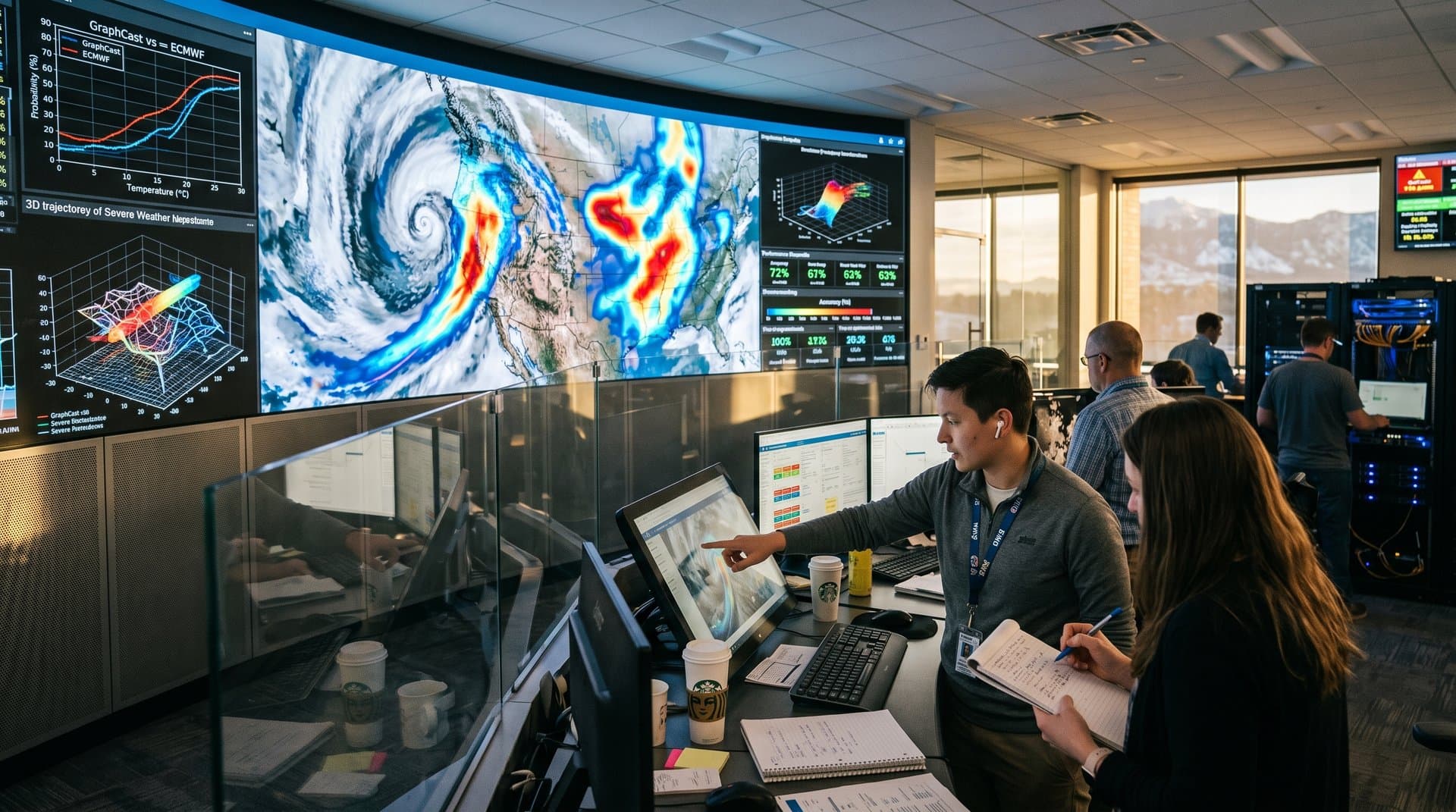
Colorado meteorologists deploy Google DeepMind's GraphCast for 10-day forecasts in under 1 minute. It beats the European Centre for Medium-Range Weather Forecasts (ECMWF) in 90% of 1,380 variables, per DeepMind benchmarks. NOAA shares these tools with Midwest offices for better tornado and flood alerts to Iowa and Illinois farmers.
National Weather Service (NWS) Boulder leads the integration. The AI processes satellite and radar data instantly. Traditional models take hours. Midwest platforms benefit from NOAA upgrades.
GraphCast Speed and Accuracy Beat Traditional Models
GraphCast trains on 40 years of ECMWF data. Neural networks predict weather from current states at 0.25-degree resolution. Google DeepMind detailed benchmarks in a blog post. Researchers led by Remi Lam published results in Nature, confirming superiority in hurricane tracks, atmospheric rivers, and weather extremes.
ECMWF's Integrated Forecasting System (IFS) needs 8 hours on supercomputers. GraphCast runs on one Google TPU v4 in less than 1 minute.
- Model: ECMWF IFS · Forecast Horizon: 15 days · Computation Time: 8 hours · Key Strength: Physics-based simulations
- Model: GraphCast · Forecast Horizon: 10 days · Computation Time: <1 minute · Key Strength: Machine learning patterns
Meteorologists chain runs to extend ranges beyond 10 days.
Colorado's Terrain Drives Rapid AI Adoption
Rocky Mountains spawn microclimates, chinook winds, and wildfire risks. NWS Boulder feeds local observations into GraphCast. GOES-16 satellites supply real-time data. The model learns from the 2021 Marshall Fire, which caused $2 billion USD in damages.
University of Colorado Boulder researchers work with NOAA on custom tuning. Precise forecasts cut insurance premiums for ski resorts and tourism operators. Swiss Re actuaries refine wildfire risk models with these outputs, per their 2023 report.
AI Connects Colorado Data to Midwest Forecasting
Jet streams from the Rockies fuel Plains tornadoes and Missouri River floods. GraphCast captures upper-level moisture flows well. Iowa State University's ag extension uses NOAA's High-Resolution Rapid Refresh (HRRR) model with machine learning boosts.
The Storm Prediction Center in Norman, Oklahoma, uses similar AI outputs for convective outlooks. Illinois farmers protect 100 million acres of corn and soybeans from hail and wind. NOAA estimates show accurate forecasts cut annual crop losses by $1-2 billion USD.
Financial Impacts Boost Heartland Agriculture
Chicago Mercantile Exchange (CME) traders use sharp predictions for corn futures. Cargill optimizes grain logistics, avoiding $500 million USD yearly in weather delays. AI cuts crop insurance claims.
NOAA's AI initiative announcement covers edge computing for 200+ radars. BEAD funding expands broadband to rural Iowa farms for real-time data.
Iowa State University trains 500 ag-tech specialists in AI forecasting each year. BNSF Railway forecasts snow on 10,000 miles of Midwest track, saving $100 million USD in delays.
Future Outlook for Midwest Economies
AI-powered weather forecasting readies for 2026 La Niña supercell thunderstorms. Multimodal models fuse radar, satellite, and sensors by 2027, per DeepMind. Indiana manufacturers avoid flood shutdowns on $50 billion USD auto supply chains.
Farmers plant confidently and secure loans at lower rates from banks like Heartland Financial. Reduced disruptions raise agriculture's GDP share by 5-10%, per University of Illinois economists. NOAA investments build Midwest resilience to climate shifts.
Frequently Asked Questions
What is AI-powered weather forecasting?
AI-powered weather forecasting uses machine learning on vast datasets for fast predictions. GraphCast processes satellite and radar data in seconds. Colorado teams target wildfires and blizzards.
How does GraphCast outperform traditional models?
GraphCast provides 10-day forecasts in under 1 minute. It tops ECMWF in 90% of 1,380 variables. Trained on 40 years of data.
How does it benefit Midwest forecasting?
AI links Rockies to Plains tornadoes and floods. Iowa and Illinois get sharp alerts. Protects 100 million acres of crops.
What is NOAA's role?
NOAA builds AI into HRRR and national tools. Boulder shares mountain data. Midwest regions access upgrades.